RESINSURF
RESINSURF’s main objective is to develop new ways of treating surfaces without using hexavalent chromium, particularly in the process known as “hard chrome plating.”
Click here to visit the official website
Start Date: 01-01-2024
End Date: 31-12-2026
Total eligible cost: 1.960.751,46 euros
European Union financial support: ERDF – 1.470.563,61 euros
Hexavalent chromium is a highly useful chemical in various industries, but it is also very dangerous for health and the environment. It is commonly used for metal coating, making paints, and treating leather, but it can cause cancer and contaminate water and soil. For this reason, the European Union banned it in 2017, although it allowed its continued use in small quantities until 2024. This has created a problem for companies that use it, as they need to find safe alternatives quickly.
To address this challenge, the RESINSURF project was created. Its main objective is to develop new ways of treating surfaces without using hexavalent chromium, especially in the process called “hard chrome plating”.
RESINSURF has two important goals:
(1) Create new, safer, and more environmentally friendly technologies to replace hexavalent chromium.
(2) Teach students and professionals how to use these new technologies.
How the project works
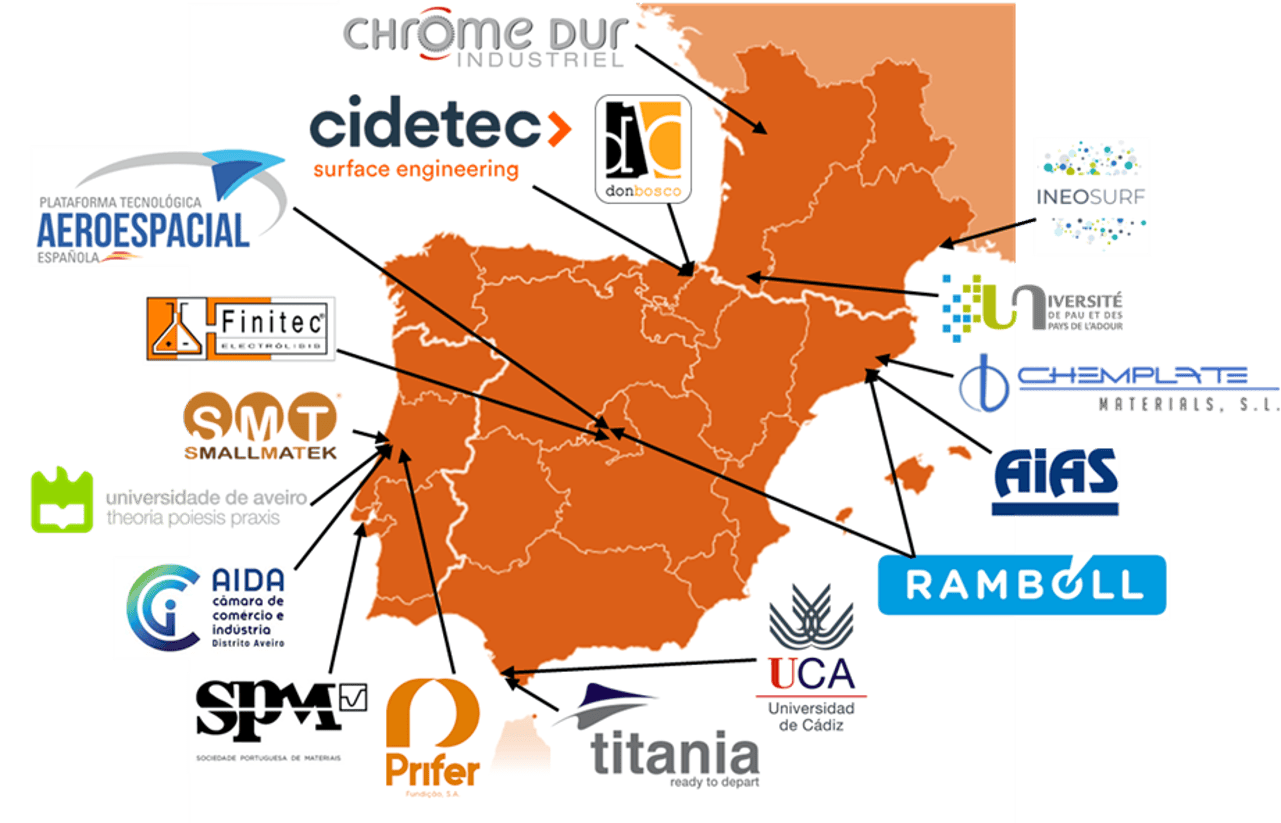
RESINSURF is working in several countries in southern Europe (Spain, France, and Portugal).
The plan includes:
- >Developing two pilot projects to test the new technologies.
- >Using digital systems to monitor these new processes.
- >Testing these technologies in real companies.
- >Organizing courses, workshops, and events to teach about these new techniques.
- >Sharing information about advancements through social media and industrial associations.
This project will help companies continue working without using dangerous products, thus protecting workers’ health and the environment, while complying with new European Union regulations.
The corrosion inhibitors developed by SMALLMATEK are being tested in Pilot 2: Chromium-free treatment of aluminium surfaces.
Pilot 2: TRADITIONAL PROTECTION of ALUMINUM alloys uses layers containing HEXAVALENT CHROMIUM, a TOXIC chemical. Due to restrictions in Europe, safer ALTERNATIVES are being sought, such as tartaric-sulfuric and boric-sulfuric ANODIZING, which do not contain chromium. In this project, TWO completely CHROMIUM-FREE METHODS will be developed and optimized: a tartaric-sulfuric anodic layer and conversion coatings, which improve the metal's corrosion resistance. Additionally, CORROSION INHIBITORS will be tested and methods will be implemented to control the quality of treatments applied to metal parts.
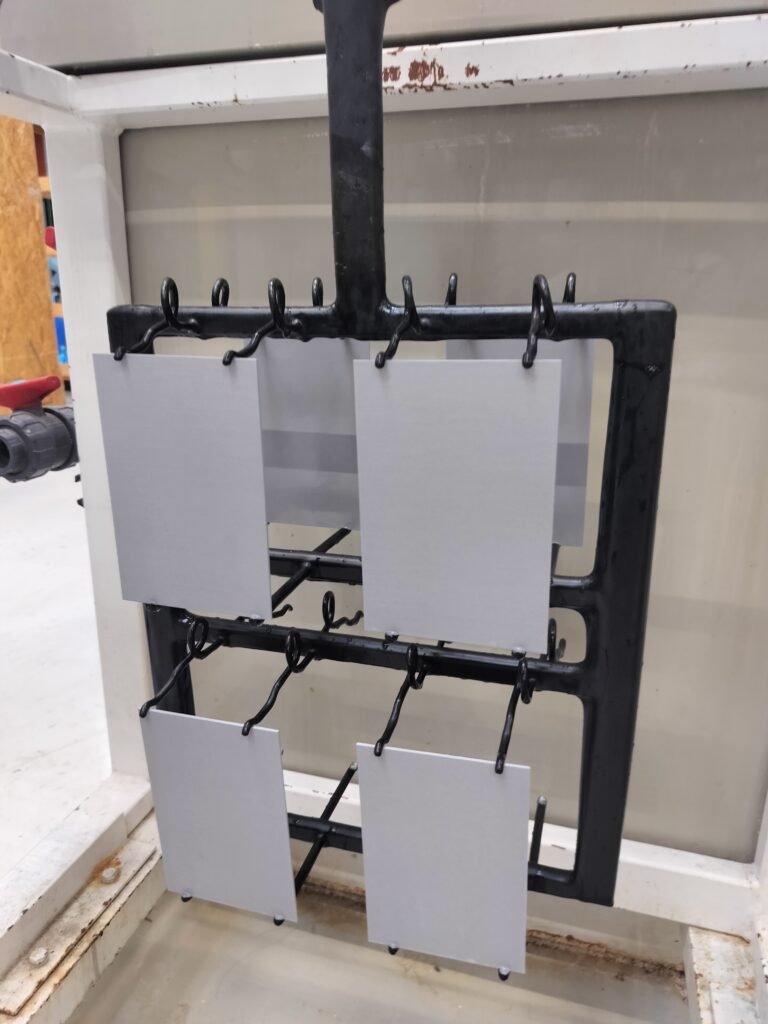
Description
Aluminium surface treatment without Cr
The RESINSURF project is launching two important pilots to replace environmentally harmful chemicals with safer and more sustainable alternatives in the regions comprising the SUDOE area.
Traditional protection of aluminum alloys uses a multi-layer system that includes chemicals with hexavalent chromium (Cr(VI)), which is toxic. Due to restrictions in Europe, safer alternatives have been found. For example, chromic anodizing has been replaced by methods such as tartaric-sulfuric and boric-sulfuric anodizing, which do not contain Cr(VI). Currently, research is being conducted on the creation of completely chrome-free primers and coatings, using techniques such as sol-gel and organic coatings with inhibitors.
In this Project, two completely chrome-free alternatives will be developed and optimized. The main difference between the two is the generation of the first treatment layer, the one closest to the surface. The following will be tested:
1-Tartaric-sulfuric anodic layer: This is a coating applied to aluminum to protect it from corrosion, using a process that does not include hexavalent chromium, making it safer for the environment.
2-Conversion layers: These are coatings that transform the metal surface into a protective layer through a chemical process, improving its corrosion resistance and increasing its durability.
For the anodic layer alternative, the addition of corrosion inhibitors, developed by SMALLMATEK, will also be tested.
In parallel, work will be done on implementing monitoring and control methods for the formulas (or baths) used and the final parts, to have efficient control of the evolution of the baths and guarantee the quality of the treated metal parts.
The following institutions participate in the development and implementation of this pilot:
CIDETEC, SMALLMATEK, and the University of Aveiro.
The validation of Pilot 2 will be carried out at: TITANIA

NanoBioEscudo
NanoBioEscudo - New generation bio-inspired technologies for the prevention of marine biofouling

SMALLMATEK 4.0
SMALLMATEK 4.0 - It aims to improve and automate Smallmatek’s production process through digitalization, making it more efficient.
NATURAL
NATURAL - Nano-clays for the removal/capture of phosphates (P) and their reuse as fertilizer